Table Of Content
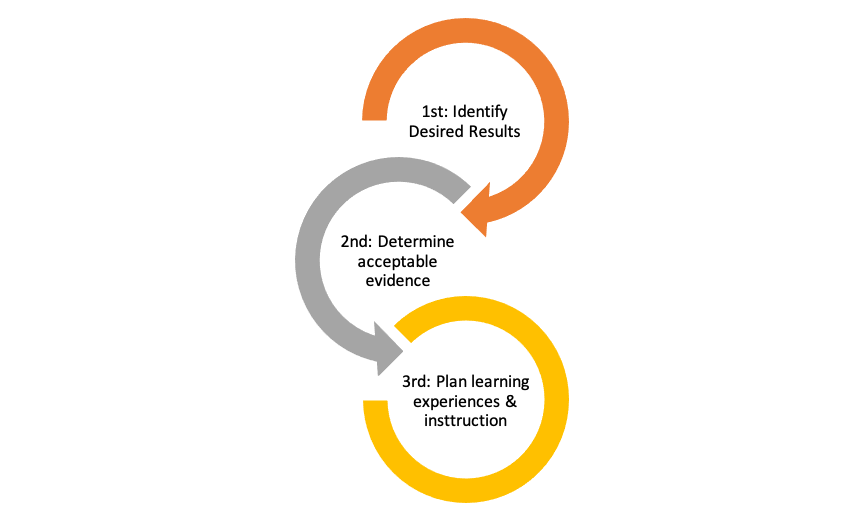
Teams of teachers often find it easier to brainstorm learning goals, assessment methods, and instructional strategies. Renowned educator Carol Ann Tomlinson, who we mentioned earlier, supports the idea of collaborative teaching and planning. The backward design approach to curriculum development first establishes educational goals and then builds assessment and instruction to serve those goals.
Sustainability begins with design - IBM
Sustainability begins with design.
Posted: Wed, 15 Feb 2023 08:00:00 GMT [source]
Aligning assessments & instruction
This stands in contrast to traditional methods where assessment can sometimes feel disconnected from the teaching. In the second stage of backward design, instructors create the assessments students will complete in order to demonstrate evidence of learning and even progress towards achievement of the learning objectives. Students will also need support to know how to prepare for assignments, to evaluate their work, and to understand their performance. Consider how your teaching strategies and learning activities will explicitly prepare students for assignments and how you can provide tangible feedback on their progress. For example, you might present exemplars and non-exemplars of student work, incorporate checklists for self- and peer review, or simply walk through and discuss the assignment instructions and rubrics you develop explicitly with students. At this point, you have determined what students will know and be able to do by the end of your course.
Traditional vs. Backward Planning
In Understanding by Design, Wiggins and McTighe argue that backward design is focused primarily on student learning and understanding. When teachers are designing lessons, units, or courses, they often focus on the activities and instruction rather than the outputs of the instruction. Therefore, it can be stated that teachers often focus more on teaching rather than learning.
Assessments
These theories collectively validate why Backward Design is more than a passing trend; it's a research-based, effective approach to education. The concept of Backward Design was invented by two education experts named Grant Wiggins and Jay McTighe in the late 1990s. Their goal was to make learning more focused and useful, not just for kids in school but also for adults in professional settings. The emphasis was on “lectures” and “discussions” and the assumption was that learning largely consisted of a passive activity in which students received information and ideas from authoritative sources.
The most important decision for a curriculum committee to make regarding which design to use should be based on what is most appropriate for the school or district. The older version (version 1.0) can also be downloaded at the Jay McTighe site previously mentioned, as well as other resources relevant to Understanding by Design. By grades 11–12, students in California public schools should be able to “use precise language, domain-specific vocabulary, and techniques such as metaphor, simile, and analogy to manage the complexity of the topic,” in works of literature. “Aligning teaching for constructive learning.” Higher Education Academy Discussion Paper. This condition might be a tool, reference, aid, or context that students will or will not be able to use.
Situated Learning Theory (Lave)
When designing lessons, ensure your instructional strategies and course design both emphasize the knowledge and skills your students need to achieve the learning goals you set/identified earlier. Besides the final assessment, teachers can gather evidence of student learning by building regular formative assessments into their lessons or units. Formative assessments can include short quizzes, peer evaluations, discussions, one-on-one student-teacher interviews and student self-reflections. The intention of these progress assessments should be to gauge abilities like critical thinking, inquiry, problem-solving and foundational knowledge as it pertains to the course content.
Visit the department's Beginning Teacher information hub
Since it’s already the beginning of summer, he has only a few months before he’ll be distributing the syllabus... Asking a person to develop a model is a much higher-order task than asking them to copy a model. Describing systems and patterns is way more challenging than selecting the correct description. Instead of starting with a topic, we’d do better if we start with an end goal, and that’s where backward design comes in. Backward Design Template with Descriptions (click link for template with descriptions). In theory, this will mean that every test your students take is relevant and helpful and shows them exactly what they do and do not need to do in order to pass your course.
What is backwards design in a lesson plan?
Instead, employees get active, engaging training that equips them to do their jobs better. Get articles with higher ed trends, teaching tips and expert advice delivered straight to your inbox. Use the following step-by-step approach to backward design your next course.

Contrast with Traditional Forward Design
You may want to refer to the Backwards Design Lesson Planning Template SAMPLE as a guide. This helps educators hone in on the most valuable and important educational content first, which is what students should have a lasting understanding of. It also highlights important information and skills students should have, and also what knowledge is important for students to be familiar with. In defining specific course goals, many teachers make use of A Taxonomy for Learning, Teaching and Assessing (Anderson, Krathwohl, 2001) as a guide. This taxonomy describes cognitive learning processes with respect to increasing levels of abstraction and complexity, from basic to advanced, around which goals can be organized. Teachers like Carol Ann Tomlinson, known for her work on differentiated instruction, have noted that when students understand what they're working towards, they are often more engaged and motivated.
Backward design is a method of curriculum planning that seeks to align standards, activities, and assessments. The method is discussed in the book Understanding by Design by Grant Wiggins and Jay McTighe. They emphasize that the most important aspect of this method is the alignment of learning activities for students with assessments and learning goals. The framework also emphasizes the transfer of knowledge, where teachers serve as facilitators of that transference. The authors posit that backward design is beneficial because it is focused on student learning and understanding, as well as bringing intentionality to curriculum design. In contrast, the backward design approach has instructors consider the learning goals of the course first.
A 6-unit, online, self-paced course for K–12 educators seeking to engage students while adhering to standards. Since its publication in the 1990s, Understanding by Design has evolved in series of popular books, videos, and other resources. Criterion – How WELL the learner must perform to demonstrate content mastery. This refers to a degree of accuracy, the number of correct responses, or perhaps a teacher-imposed time limit. In this instance, you will need to decide if you intend to teach all of this at once as a unit or if you will break these concepts into smaller chunks.
Whether the goal is simply to remember dates or analyze historical events, Backward Design helps educators map out a targeted learning path to achieve the desired complexity level. In a classroom influenced by Constructivist principles, students are actively engaged, asking questions, and building their own understanding. Backward Design aligns with Constructivism by initiating the learning process with a clear objective. Knowing this goal helps learners actively construct the knowledge required to achieve it. Performance tasks determine what students will demonstrate and what evidence will prove their understanding. Learning outcomes and/or objectives should target complex skills and knowledge, by implementing Bloom's terminology into a learning outcome instructors can help students understand what they need to do in order to meet the desired results.
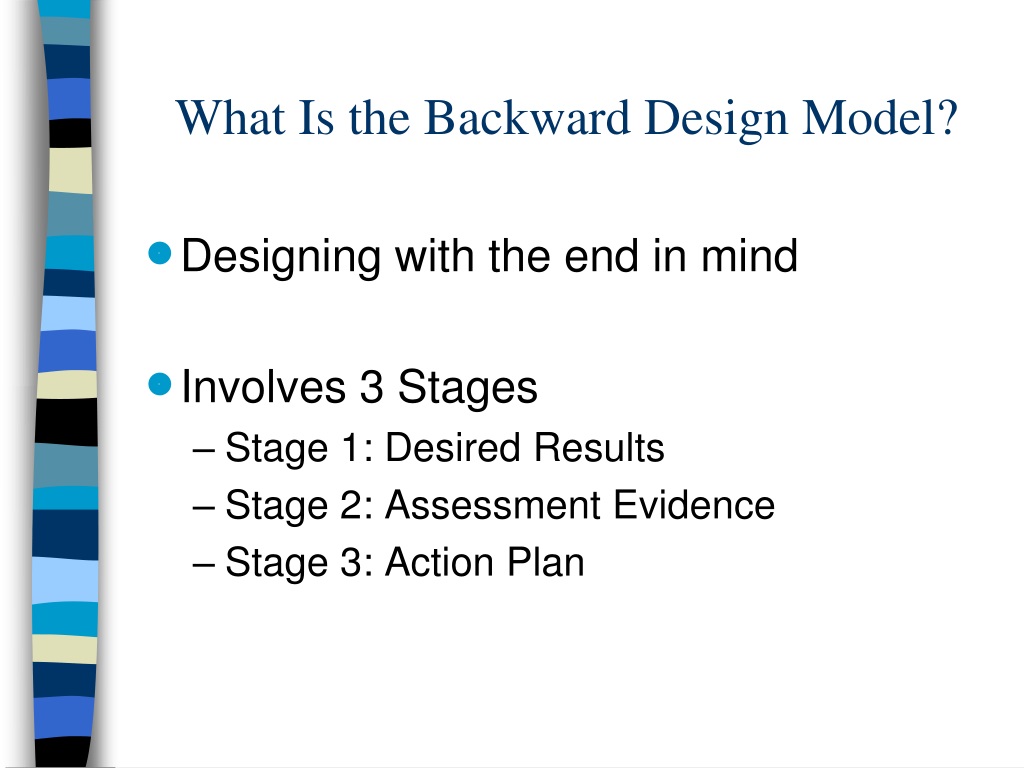
This perspective can lead to the misconception that learning is the activity when, in fact, learning is derived from a careful consideration of the meaning of the activity. In Understanding by Design, Wiggins and McTighe argue that backward design is focused primarily on student learning and understanding. The idea in backward design is to teach toward the "end point" or learning goals, which typically ensures that content taught remains focused and organized. This, in turn, aims at promoting better understanding of the content or processes to be learned for students. The educator is able to focus on addressing what the students need to learn, what data can be collected to show that the students have learned the desired outcomes (or learning standards) and how to ensure the students will learn.
Evaluation of backward Lagrangian stochastic (bLS) model to estimate gas emissions from complex sources based on ... - ScienceDirect.com
Evaluation of backward Lagrangian stochastic (bLS) model to estimate gas emissions from complex sources based on ....
Posted: Fri, 11 Oct 2019 07:05:48 GMT [source]
Let’s take a look at an example to illustrate the difference between a unit planned the traditional, topic-driven way, and the same unit planned with backward design. This teaching guide is licensed under a Creative Commons Attribution-NonCommercial 4.0 International License. Information that fits within this question is the lowest priority content information that will be mentioned in the lesson, unit, or course.
Traditional design lesson plans review standards or learning objectives (which can be federal, national, or personal). Backward design helps teachers create courses and units that are focused on the goal (learning) rather than the process (teaching). Because “beginning with the end” is often a counterintuitive process, backward design gives educators a structure they can follow when creating a curriculum and planning their instructional process. Advocates of backward design would argue that the instructional process should serve the goals; the goals—and the results for students—should not be determined by the process.




No comments:
Post a Comment